
Menu
The P/F ratio is a powerful objective tool to identify acute hypoxemic respiratory failure when supplemental oxygen has already been administered and no room air ABG is available, or pulse oximetry readings are unreliable.
The diagnostic criteria for acute hypoxemic respiratory failure is:
The P/F ratio indicates what the PaO2 would be on room air (if patient was taken off oxygen):
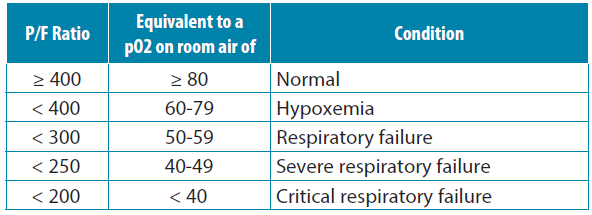
The P/F ratio should not be used to diagnose acute on chronic respiratory failure since many patients with chronic respiratory failure already have a P/F ratio < 300 (PaO2 < 60) in their baseline stable state which is why they are treated with chronic supplemental home oxygen.
Note that PaO2 and pO2 are synonymous.
Get our CDI Pocket Guide® for more help with the P/F ratio.
“P” represents PaO2 (arterial pO2) from the ABG. “F” represents the FIO2 – the fraction (percent) of inspired oxygen that the patient is receiving expressed as a decimal (40% oxygen = FIO2 of 0.40). P divided by F = P/F ratio.
Example:
PaO2 = 90 on 40% oxygen (FIO2 = 0.40): 90 / 0.40 = P/F ratio = 225.
A P/F ratio of 225 is equivalent to a pO2 of 45 mmHg, which is significantly < 60 mmHg on room air.
A nasal cannula provides oxygen at adjustable flow rates in liters of oxygen per minute (L/min or “LPM”). The actual FIO2 (percent oxygen) delivered by nasal cannula is somewhat variable and less reliable than with a mask but can be estimated as shown in the Table below as the accepted clinical standard for the conversion. The FIO2 derived from nasal cannula flow rates can then be used to calculate the P/F ratio. Note: Assumes room air is 20% (0.20) and each L/min of oxygen = +4% (0.04).
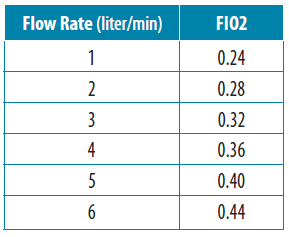
Example: A patient has a pO2 of 85mmHg on ABG while receiving 5 liters/minute of oxygen. 5 L/min = 40% oxygen = FIO2 of 0.40. The P/F ratio = 85 divided by 0.40 = 212.5.
The S/F (SpO2/FIO2) ratio serves as an alternative to the P/F ratio for identifying acute hypoxemic respiratory failure and is increasingly being used in clinical practice. Utilizing the SpO2 and S/F ratio allows healthcare providers to avoid painful arterial blood gas sampling and enables immediate calculation without waiting for ABG analysis. The S/F ratio is determined by dividing SpO2 by FIO2.
Multiple sources in the medical literature indicate that the correlation between S/F and P/F ratios can be expressed with the formula: S/F = 64 + 0.84 × (P/F). Based on this calculation, an S/F ratio of 315 or lower is indicative of acute hypoxemic respiratory failure, similar to a P/F ratio under 300.
| P/F Ratio | S/F Ratio |
|---|---|
| < 300 | <= 315 |
| < 250 | <= 274 |
| < 200 | <= 232 |
However, the recent update to the Sequential Organ Failure Assessment (SOFA) score (published 10/29/2025), referred to as SOFA-2, includes equivalent S/F ratios as:
| P/F Ratio | S/F Ratio |
|---|---|
| <= 300 | <= 300 |
| <= 225 | <= 250 |
| <= 150 | <= 200 |
Regardless of which equivalent S/F ratios are applied, it is important to recognize that neither the S/F nor the P/F ratio independently confirms acute hypoxemic respiratory failure; these measures should be interpreted in the context of other clinical parameters and the patient's baseline status.
Copyright (c) 2019-2025 Pinson & Tang LLC.
Contact Customer Service at (713) 292-9412 or [email protected]

